Processing is a flexible software sketchbook and a language for learning how to code. Since 2001, Processing has promoted software literacy within the visual arts and visual literacy within technology.
Processing uses the Java programming language, with additional simplifications such as additional classes and aliased mathematical functions and operations. It also provides a graphical user interface for simplifying the compilation and execution stage.
Processing is an open source programming language and environment to create images, animations, and interactions. Initially developed to teach fundamentals of computer programming within a visual context, Processing also has evolved into a tool for generating finished professional work.
The 99 ENTERPRISE DR USPS location is classified as a Mail Process: Processing and Distribution Center/Facility (PDC/PDF). They are located in NEWBURGH, NY. Their profile includes traditional and mobile directions, maps, reviews, drop-off and pick up hours (where available), and their phone number.
Processing is not exactly an application in the traditional sense, but rather a tool that can help you learn how to code via computer graphics, animations and visual art.
Processing was created in 2001 by Ben Fry and Casey Reas, who were both students at the Massachusetts Institute of Technology (MIT) at the time. They wanted to create a programming language that was easy to learn and use, while still being powerful enough to create complex interactive applications.
Initially created to serve as a software sketchbook and to teach programming fundamentals within a visual context, Processing has also evolved into a development tool for professionals. The...
Returns the number of milliseconds (thousandths of a second) since the sketch started. Writes array data to the text area of the Processing environment's console.
Processing allows people to create sketches at two levels of complexity that we call "static" and "active" sketches. People new to programming often begin with static sketches to learn about coordinates, variables, and other basics before moving to active sketches.
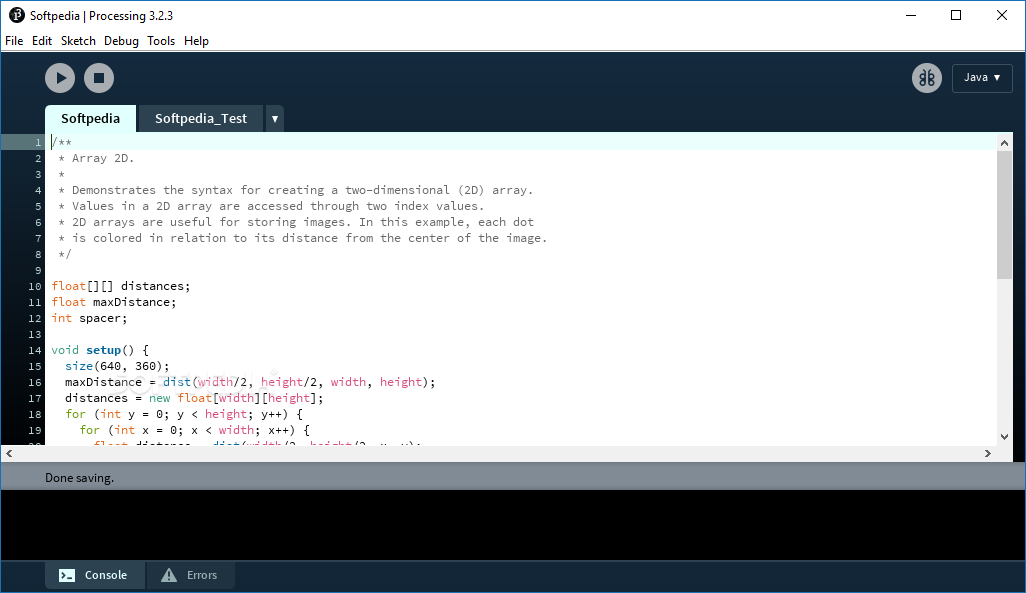 Processing is not exactly an application in the traditional sense, but rather a tool that can help you learn how to code via computer graphics, animations and visual art.